
Miami-Dade Insurance Costs Still Bite on Seven-Figure Homes
Insurance rates in Miami-Dade County are finally moving in the right direction. A reduction of about 10.5% is taking shape. For buyers who lived through the peak prices of recent years, that is genuinely good news.
But here is what out-of-state buyers relocating from the Northeast, Midwest, or California rarely see coming. On a luxury home priced over a million dollars in Palmetto Bay or Pinecrest, you do not carry just one insurance policy. It’s actually three separate policies.
Understanding your full monthly insurance bills before you write an offer is essential at the luxury tier. It represents the difference between a home purchase that feels comfortable and one that quietly erodes your returns from day one.
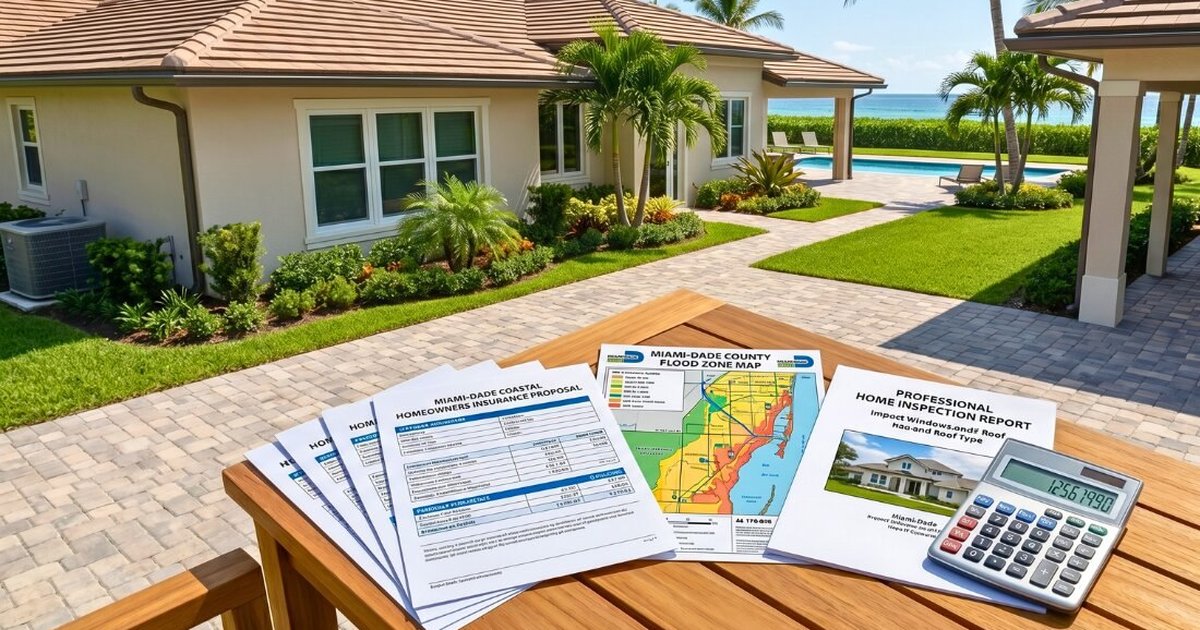
Luxury homeowners in Miami-Dade typically carry three separate policies: homeowners, flood, and windstorm. On a home priced at $1M or more, combined premiums can reach $1,500 to $2,000 per month. The condition of the home, including roof age, electrical panel, plumbing type, and impact windows, directly determines what you pay.
Insurance Considerations for Out-of-State Luxury Homebuyers
This three-policy reality shapes every home-buying conversation with families who are new to the South Florida market. Buyers moving from the Midwest are often used to carrying standard homeowners policies that cost only $300 to $500 per month.
Landing at a combined total of $1,500 to $2,000 per month for a luxury property requires a significant budget adjustment. The home buyers who handle this change smoothly are the ones who studied the math before making an offer.
The structure of South Florida property coverage is straightforward once you learn the rules. Most seven-figure properties in Miami-Dade County require a general homeowners policy, a separate flood policy, and a windstorm policy.
Properties in high-elevation neighborhoods may be exempt from the flood policy rule, reducing your required insurance package to just two policies. For waterfront residences or homes built on low-lying ground, all three lines are standard.
“When we sit a buyer down, we go through the three big costs: mortgage payment, interest rate, and insurance. Insurance costs on a million-dollar house can be $10,000 a year because you have to carry flood, homeowners, and windstorm. When we’re talking about expensive homes, five million plus, you’re talking about $2,000 a month.” – Adam Levy, Broker Associate, The Levy Group at Compass
Property Condition Drives Insurance Costs
Insurance underwriters in Florida do not just set a price for coverage. The company is insuring a physical asset, and they assess that asset using two key forms. One is the four-point inspection, and the other is the wind mitigation report.
The four-point report covers the roof, electrical, plumbing, and HVAC. The wind mitigation report covers roof attachments and opening protection. Together, those reports largely determine your premium and whether the insurer will cover the property at all.
A tile or metal roof replacement in South Florida runs approximately $50,000. An aging electrical panel can trigger coverage refusals from multiple carriers. Unlined cast iron pipes create similar insurance problems.
These are not cosmetic details. They are underwriting red flags that can cause a deal to collapse. This isn’t about a buyer and seller disagreeing on price. The problem is that no insurer will step in at terms that make the numbers work.
The calculus runs in the other direction, too. A home with a newer roof, updated electrical panel, PVC plumbing, and impact windows delivers real relief on carrying costs. When a listing comes in with an eight-year-old roof, that is one fewer variable for a buyer to absorb, and one box the agent can confidently check.
Several private carriers re-entered the Florida market in 2025 and 2026. That means competition is increasing, but the condition-based variation in actual premiums remains wide.
“The insurance has gotten a little bit better, but it’s still out of control. Having bad pipes, an old cast iron system, a bad panel, a bad roof, no impact windows, these things add up to more expensive costs, year after year.” – Adam Levy, Broker Associate, The Levy Group at Compass
Walkthrough Benefits of an Agent With Real Construction Experience
I spent five years as a project manager in residential home building before working in real estate. That background helps me spot issues that other real estate agents walk right past. That doesn’t mean other agents are being careless; they just don’t have the experience or training.
One major detail most buyers overlook is the relationship between the street height and the front door. When the yard grading slopes downward from the street toward the entryway, you have a drainage problem.
Old heating and cooling ductwork inside the attic is another hidden risk that most buyers underestimate. Leaky, deteriorating air ducts lead to indoor mold growth, drywall damage, and expensive cleanup costs that multiply quickly.
These items are not a surprise if you know where to look during your first walkthrough. They become powerful negotiation tools to lower your purchase price or early warning signs that you should pass on the house.
“My 30 years of doing this and my construction background really keep me in check. I can spot deficiencies. After I see a lot of deficiencies, I might lean clients toward a more established neighborhood, or a house that’s got more tree canopy, or a house that’s got better elevation.” – Adam Levy, Broker Associate, The Levy Group at Compass
That construction knowledge functions as a form of coverage in itself. Buyers and sellers gain confidence knowing the agent can explain a home’s physical condition and what repairs may be required. For a closer look, read our recent post about crucial home inspection details in South Florida.
How 2026 Rate Movement Is Impacting Buyers
The recent premium price reductions are real, and they matter to your bottom line. But the financial gap between an updated home and one with aging mechanical systems remains wide enough to change your annual housing budget. A 10% drop in overall market rates still leaves a significant price difference between a house with full-impact windows and one without protection.
The Florida Office of Insurance Regulation tracks these changing market trends, and the return of private carriers is an excellent sign for our local economy. Still, for buyers moving here from out of state, that massive price spread between properties is hard to see without an expert guide. The smart move is to understand the full cost of homeownership before you fall in love with a kitchen.
Common Questions About Miami Home Insurance Costs
How much does homeowners insurance cost on a million-dollar home in Miami-Dade?
Annual premiums on a million-dollar home in Miami-Dade County generally range from $8,000 to $12,000 or more. Your total bill depends heavily on the roof age, plumbing materials, electrical wiring safety, and whether your bank requires flood coverage. At the high-end luxury tier, combined annual bills can easily reach $2,000 per month. The physical condition of the building is just as important as the purchase price.
Do I really need three separate insurance policies in South Florida?
Most seven-figure properties in Miami-Dade County require three separate policies. You’ll need general homeowners insurance, windstorm coverage, and a flood policy through the National Flood Insurance Program or a private company. Properties on high ground outside designated flood zones often skip the flood policy rule. That reduces your required insurance stack to just two forms of coverage.
What is a wind mitigation report, and how does it affect my premium?
A wind safety report documents how well a home is built to withstand hurricane-force winds. It details your roof construction style, how the roof deck attaches to the walls, and whether there are impact windows or doors. Properties with high safety scores receive significant credits, often lowering the windstorm portion of your bill by 20% to 40%.
Will impact windows lower my insurance premium in South Florida?
Yes, impact-rated windows and doors are effective for lowering your windstorm premiums. They satisfy the strict opening protection rule on your wind safety report, which directly triggers a major discount on your policy. These monthly savings add up quickly over time and represent a major financial factor when comparing two similar homes.
Are Miami-Dade insurance rates improving?
Yes, local rates are showing real signs of improvement. Several private insurance carriers have re-entered the Florida market, increasing competition and stabilizing pricing. Rates remain higher than in most other states, and the physical condition of individual houses continues to drive costs. This market drop is a great baseline, not a fixed ceiling.
Can a seller’s insurance history affect my ability to get coverage on a home I want to buy?
Yes, prior claims filed on a house can impact your new policy options. Water damage or roof claims appear in a special insurance database known as a CLUE report. This history can make it harder to secure coverage or lead to higher premiums. Asking for a clean claims record during your inspection period is standard practice for knowledgeable buyers.
How do renovation choices affect insurance costs on a South Florida home?
Targeted updates can lower your insurance costs. High-value projects include installing a new roof, replacing old electrical boxes, installing PVC pipes, and adding impact windows. Buyers comparing an updated house to an older home should factor in the difference in annual insurance premiums.
Know Your Full Carrying Costs Before You Buy
The insurance picture on a South Florida luxury home is more complex than most out-of-state buyers expect. Understanding the math before you write an offer is the difference between a good purchase and one that creates ongoing financial stress.
If you want a property assessment from someone with construction expertise, contact The Levy Group. We can provide a deeper understanding of a property’s condition and how these factors influence long-term costs.
ABOUT THE EXPERT
Adam Levy | Broker Associate, The Levy Group at Compass | Licensed since 1997 | 1,000+ career transactions at a seven-figure average sale price | Member, Master Brokers Forum (MBF), top 1% of 46,000+ licensed agents, Miami Board of REALTORS® | University of Florida, School of Building Construction | State of Florida Certified Residential Contractor | Ranked #1 in office at Coldwell Banker and Berkshire Hathaway for 20+ consecutive years

Comments are closed.